

Celebrating 50 Years at the Helm: Mayor William D. Tate (J.D. ’68) and the Transformation of Grapevine
Quick summary: Mayor William D. Tate (J.D. ’68), the longest-serving mayor in Texas history, reflects on his 50-year career leading Grapevine. A University of Houston Law Center alumnus, Tate discusses how his legal training helped transform a quiet agricultural town into a major international destination while preserving its historic character.
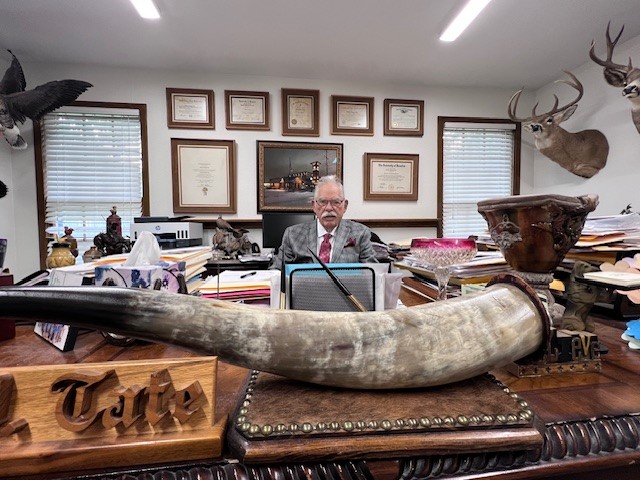
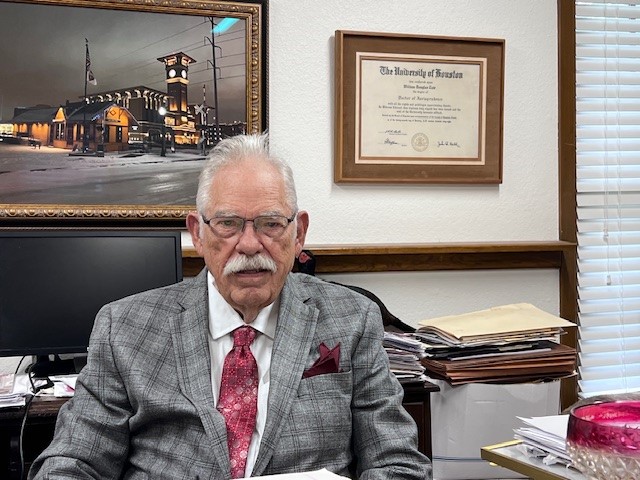
Tate recently spoke with the UH Law Center to reflect on his career in public service.
Question: You graduated from law school in 1968 and took office as mayor in 1973, just as DFW International Airport was transforming the region. How did your legal training prepare you to handle the zoning, tax agreements and municipal contracts that drove Grapevine’s early growth?
Mayor Tate: It was invaluable to me to have the legal training because it gave me a different insight into how to evaluate issues and solve them. Coupled with my accounting undergraduate degree from North Texas, it helped me put together a business plan on sales tax to allow us to overcome the limitation we had—about two-thirds of our land was not taxable for ad valorem taxes because it was owned by exempt taxpayers, such as the airport and Lake Grapevine. We had to figure out a solution to increase the tax base and increase the quality of life for Grapevine citizens.
When you’re a lawyer, you look at things differently—you analyze more. You want to know what the truth is. You have to rely on the actual facts and be able to prove them. Being able to analyze the alternatives and develop a plan and a solution is part of a lawyer’s day, and those skills are very valuable, not only as mayor, but in any walk of life.
Question: Grapevine has attracted major developments like Grapevine Mills, the Gaylord Texan and TEXRail while preserving its historic Main Street. From a legal and planning standpoint, how did you balance rapid economic expansion with protecting the city’s 19th-century character?
Mayor Tate:It’s something very unique because, naturally, it doesn’t happen that way. Towns either just die out, shrink or waste away, or developers come in and want to tear down something old and replace it with something new. To keep that from happening, you have to develop a plan and work very hard to reverse those trends, and you need the cooperation of the citizens and property owners.
We worked, first, on becoming a Main Street accredited entity. When the state historic society turned us down for grants because they wanted to focus on rural areas, we created our own Main Street program and our own grant program and hired an administrator. We worked with property owners to get them to invest and refurbish their buildings. That meant you could attract better businesses—instead of warehouses and antique stores, we started getting women’s dress shops, nice restaurants and tasting rooms.
We also had to rezone the entire town to get our zoning in balance with our master plan. No other city in Texas has ever done that. The city was the applicant; we filed zoning applications for every property in town, paid the fees, held public hearings and rezoned the entire town. I’m proud to say we didn’t get any lawsuits as a result.
Question: You are the longest-serving mayor in Texas history. Over five decades, what has been your core leadership philosophy, and how have you sustained public trust through changing political and economic conditions?
Mayor Tate:It started with my childhood and my special connection with the people who lived in the community. I was exposed to the opinions and attitudes of the people through my father's hardware store, where men visited and sat around the fire and talked about their hopes and dreams for the city.
I learned from that, and I heard it again during the airport construction as our city was transitioning into an international city. People said, "Mayor, whatever you do, don't lose our small-town feel, our traditions, our heritage and our identity." And we work very hard to preserve that. We had to create new ordinances, the residential historic district and overlay ordinances. We had to create laws that would enforce and encourage people to follow a trend and a plan that would create the desired result.
Question: Grapevine’s success is closely tied to regional partners, including DFW International Airport and neighboring cities. How has your legal background shaped your approach to negotiating and advocating for Grapevine at the regional level?
Mayor Tate:Under Texas law, cities were growing together and they had extraterritorial power beyond their limits. Those overlapped all around Grapevine. So, the first thing we did was solidify our boundaries. We reached boundary line agreements with all of our neighboring cities and prorated the extra jurisdiction that we had outside city limits. That paid big dividends because we weren’t in disputes with cities over land use and boundary disputes.
We also had four "airport cities" that the airport was built on. There were issues including where to file traffic tickets and who would provide police and fire protection. Those issues were resolved with the four cities, and eventually the airport started changing the laws and became a "city within the city." They have special laws that give them those powers, but those initial negotiations were quite complicated and conducted by lawyers.
Question: Grapevine is now known as the “Christmas Capital of Texas” and a hub for the state’s wine industry. What legal, policy or partnership decisions were most critical in building and sustaining that identity?
Mayor Tate: For the Christmas Capital, we went to the state legislature, and the Senate designated Grapevine as the Christmas Capital of Texas. Then we copyrighted that with the federal government. I worried about that a little bit because Christmas belongs to everybody, but we were able to create so many entities, events and activities that it became clear that we really were the Christmas Capital.
With the wine industry, we got involved in trying to promote Texas wine, which originated primarily as hobbies. We supported the winemakers and helped get them organized under state law. We changed the way they were regulated through the legislature, and then we started GrapeFest, which is now the largest wine festival in the Southwest. It got people involved volunteering in our community, and the opportunity for citizens to give back became a huge part of our success.
Question: Thinking back to your time at the University of Houston Law Center, what stands out most—whether a professor, a class or relationships that shaped your career?
Mayor Tate:In my very first class the teacher said: "Forget all the English you ever learned; we use the language for persuasion, not for grammar." I knew I was in the right spot there because I was never that good at grammar!
You learn really quick that you have to be prepared. It’s a full-time job every night reading cases and being put on the spot by the professor the next day. If you weren't prepared, you were embarrassed and ridiculed. So, it taught me to be a better student.
They also reshape your personality. I was timid growing up—I was bashful—and I had to overcome that. They made me very tough, and they made me very fair. If you're a lawyer, you want fairness and justice. They taught me to examine every issue and every problem, find a solution, and then be able to support those conclusions.
Question: Many law students hope to make a meaningful impact through public service or legal practice. Based on your career, what advice would you offer those who want to lead and serve their communities over the long term?
Mayor Tate: I think people need to do what government is designed to do. They need to represent the people and not themselves or their own ideals. To do that, they need to listen to the people and see what their ideals are.
People want more for less out of government. They pay taxes, and they want something from it—they're entitled to it. So many politicians get elected for their own motivation or their own agenda, and people get caught without anybody really supporting them. I think that's what makes our story so unique because we just did the opposite. We represent the people, we give them what they want, and they're very happy.

