

LawTech Expert at UH Law Center Webinar Explains How the Legal Community is Using AI, What Users Should Keep in Mind
Quick summary: Michael Livermore discussed how large language models are changing legal research, drafting and analysis during a UH Law Center Environment, Energy and Natural Resources Center webinar, while cautioning lawyers to remain alert to hallucinations, outdated information, bias, fairness, competence and confidentiality concerns.

May 29, 2026 – Artificial Intelligence is rapidly changing how lawyers research, draft and analyze legal arguments, but technology still carries significant risks for courts and law firms, according to leading legal scholar Michael Livermore at a recent University of Houston Law Center virtual webinar, titled “Large Language Models in Legal Analysis.”
The event, hosted by UHLC’s Environment, Energy and Natural Resources Center, had about 300 online attendees. It was co-moderated by Qaraman Hasan, a research scholar at the center, and Professor Tracy Hester, co-director of the EENR Center.
Livermore, the Class of 1957 Research Professor of Law and director of the LawTech Center at the University of Virginia, said the current wave of AI tools is part of a much longer history of technological changes, from Hammurabi’s Code to the printing press to computers, impacting the legal profession.
“Large language models are not the first technology that has affected legal practice, far from it,” he said. “Legal practice and legal institutions, how we do law, has always been deeply conditioned by technology, and in particular information technology.”
Unlike the older Natural Language Processing or NLP systems, which relied on specialized techniques such as topic models along with task-specific architectures in the computer algorithms to interpret and analyze legal texts, LLMs work directly with practically all legal texts and present outputs in plain language, Livermore said.
This shift makes computational legal analysis accessible to a greater number of people. All they would need is access to a tool like ChatGPT, Claude or something similar.
“There’s a lot of very deep practicalities about how to integrate these models into the workflow of law, which is really about this question of how technologies, including large language models, but other types of computational technologies, are affecting legal practice and what the kind of frontier and what the future looks like in that regard as well,” he said.
Livermore, one of the early scholars to use computational text analysis for research, discussed the opportunities and the risks associated with AI-powered legal analysis.
He outlined three key areas where LLMs are reshaping legal scholarship – feature extraction and data generation; prediction, classification and description; and engineering and benchmarking. Researchers, he said, are already using such tools to extract data from large, unstructured collections of legal documents, identify trends and forecast how legal arguments may be perceived by juries, and test models against legal benchmarks to see how effectively they perform tasks involving legal reasoning.
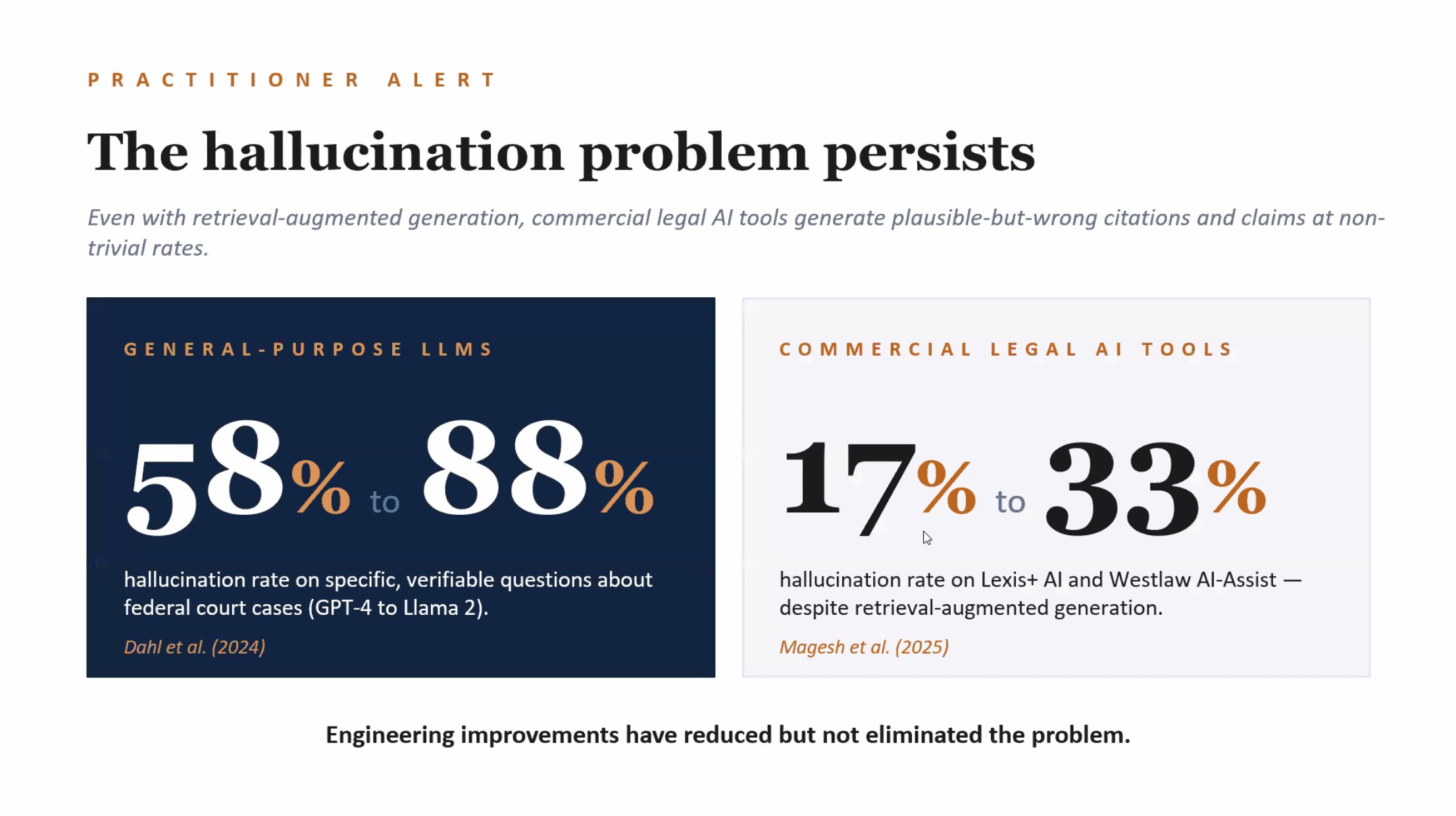
Even with the astronomical progress in LLMs, issues still exist.
“We know these models tend to fabricate information…some law firms have gotten in trouble for submitting briefs to courts where they include AI hallucinations, which primarily include fake cases that don’t exist,” Livermore said. “In research on this question of hallucination, we find quite substantial amounts of hallucinations still exist.”
Part of the problem is the plain-language output. “Large language models just produce this text that is very easy to understand, it's in English, it kind of almost auto-interprets but this can actually lead us to let our guard down a little bit,” he explained. “Lead us to kind of accept the model outputs as natural and meaningful, whereas actually we would be better served if we were …applying a certain critical lens to the outputs.”
In addition, the models are bad at addressing legal change “because they’re trained on prior data so it’s hard for them to stay updated,” said Livermore, adding concerns about bias and fairness and around competence and confidentiality to the list.
For now, he advised law firms and lawyers should use LLM tools judiciously.
“So, what does this mean? Generally, for legal practice is that large language models are in no way oracles,” Livermore said. “They're good for summarization, drafting support, but they're very bad at just telling you facts about the world in a reliable fashion. It's good to match the tools to the task.”
This webinar was part of a continuing legal education series provided through the UHLC by the EENR. The next webinar, “Reimagining the Future of US Electricity,” is slated via Zoom for 12:30 p.m. (CDT), Monday, June 1, 2026.
For more information about the Environment, Energy and Natural Resources Center, visit https://www.law.uh.edu/eenrcenter/.

