

April 10, 2026 — College athletics has changed dramatically over the last five years, capped by a 2025 court settlement that allows universities to directly pay student athletes. Panelists at a conference hosted by deans of law schools across the Big 12 athletic conference agreed that it was just the start of a broader transformation.
“We’re at the beginning stages of this. There are going to be some bumps in the road,” said Brian Michael Cooper, of counsel at Greenberg Traurig and an adjunct professor at the University of Houston Law Center. “We are nowhere close to finishing.”
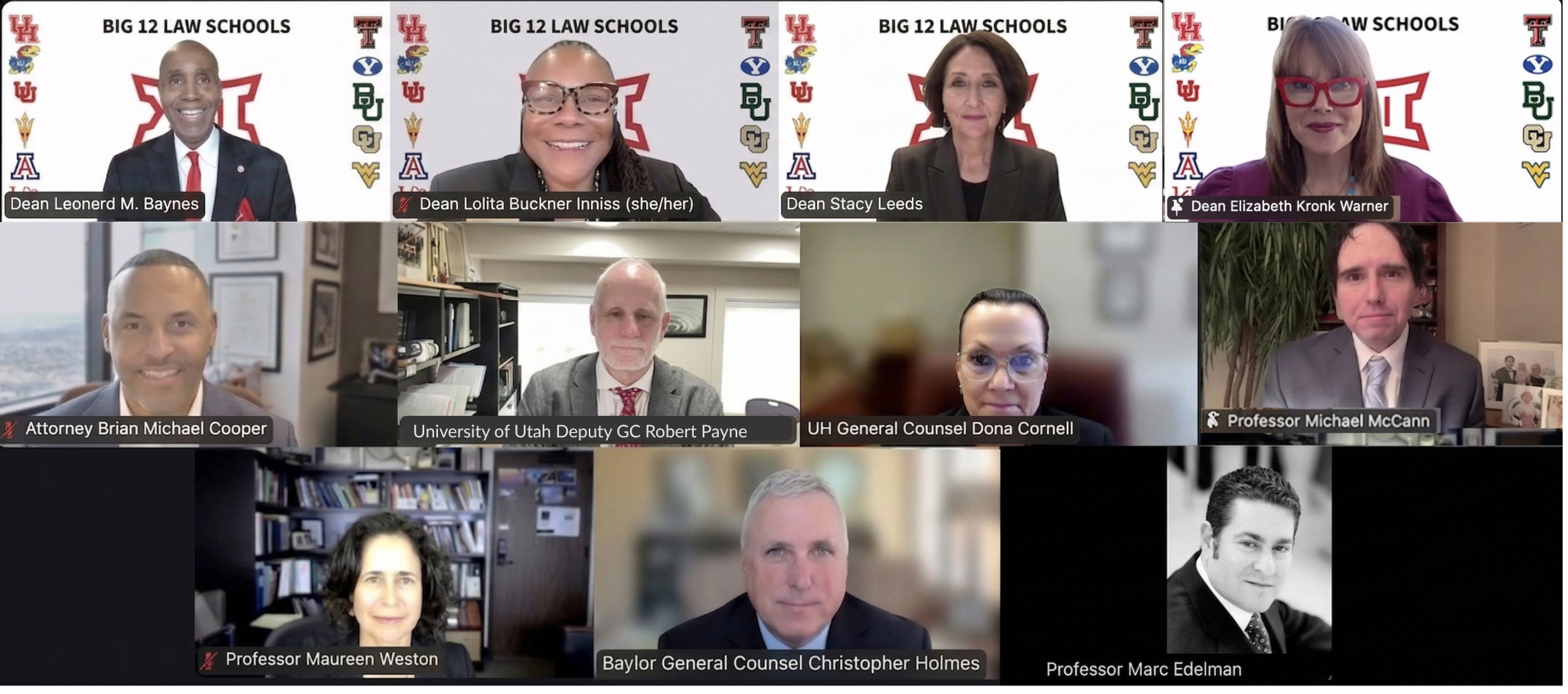
Cooper and other panelists, including the general counsels from several Big 12 schools, spoke as part of “Navigating a New Era of College Sports,” an online webinar exploring the shifting collegiate sports environment. The webinar was approved for three hours of Texas MCLE credit. Dona Cornell, vice chancellor for legal affairs and general counsel at UH, said the past few years have provided a crash course in college sports. “It’s been a wild time for all of us,” she said. “We’ve all become experts in athletics.”
Key issues remain to be addressed, including gender equity, the role of private equity or other outside investors, and perhaps most pressingly, whether student athletes should be considered employees of the universities they represent. Panelists said the shifting landscape encompasses not just sports law but also antitrust, labor, and other legal areas.
Much of the discussion focused on the House settlement, approved in June 2025, which resolved several antitrust lawsuits against the NCAA by allowing universities to directly pay student athletes. which governs college sports, improperly limited athletes’ earning power. The agreement follows the NCAA’s 2021 decision that allowed athletes to receive compensation through deals, known collectively as name, image and likeness deals, or NIL. Separate third-party NIL deals are still allowed in addition to revenue sharing, which was initially capped at $20.5 million per year per school.
Cornell drew a distinction between revenue sharing and more explicit payments. “We are paying students for their name, image, and likeness. We are not paying them to play,” she said.
The role of private equity
Financing those payments is an ongoing challenge. Robert W. Payne, deputy general counsel at the University of Utah, said schools are scrambling to determine how to fund payments to student athletes. “We all breathed a sigh of relief when the House case settled,” he said. “(But) we’re still in the soup.”
The payments aren’t mandatory, but Payne said all Power 4 conference institutions will pay their athletes, while about 80% of other institutions will provide some level of revenue sharing. “The public perception is that institutions are awash in money. That’s not true. Most (athletic) programs run a deficit,” he said. Utah is addressing the issue in part by partnering with private equity to increase revenues, becoming the first university to announce such an arrangement.
“To do nothing is not an option,” Payne said, noting that the university president did not support increasing student fees or drawing from auxiliary services to fund athletics. The goal is to work with private equity to boost revenues through such measures as improving the game day experience. “There are risks to being the first to do it, but there are advantages, too,” he said.
Concerns about gender equity and employment
Gender parity is another concern. Cooper noted that revenue sharing under the House settlement focused on revenue from media rights, with sports that garner the most from television and other media rights receiving the most. The distribution model calls for 75% of revenues to be spent on football, 15% on men’s basketball and 5% on women’s basketball, with the remaining 10% divided among the Olympic and other sports. That has translated to female athletes receiving less in compensation than their male counterparts. “If football is getting the lion’s share of the revenue, that means male students get a disproportionate share of revenue,” Cooper said.
How that fits with Title IX — the landmark 1972 law prohibiting sex-based discrimination in education — is up in the air. Title IX was extended to athletics in 1974. “We thought we understood Title IX. Don’t discriminate on the basis of sex,” Cornell said. “Now Title IX is incredibly unsettled.”
That’s just one of the looming issues. Christopher Holmes, general counsel, chief legal officer, and corporate secretary at Baylor University, said significant litigation continues, dealing with antitrust challenges to athlete compensation, eligibility, NIL, and contract issues. The major question, he said, is whether student athletes are university employees. Seven bills addressing the issues are currently pending in Congress. One, the SCORE Act, would explicitly prohibit classifying student athletes as employees.
“We are all cautiously optimistic Congress will step in and provide some guardrails,” Payne said. In the meantime, challenges and adjustments are ongoing.
“The chaos isn’t going away,” said Michael McCann, director of the Sports and Entertainment Law Institute at the University of New Hampshire Franklin Pierce School of Law. “There will be more lawsuits until there is a recognized relationship between athletes and the schools.”

