

Why Does AI Matter in Legal Education? UH Law Center Professor Chander Says Leads to Better Writing, Deeper Research and Strong Scholarship as Class Publishes Book
Quick summary: UH Law Center Professor Seth J. Chandler and students in his Advanced Constitutional Law seminar used generative AI to create a published anthology examining constitutional law issues while exploring how AI can improve legal writing, research and scholarship.

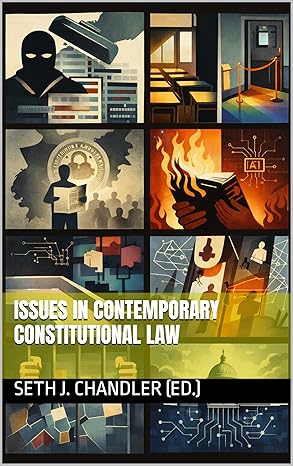
May 15, 2026—University of Houston Law Center Law Foundation Professor Seth J. Chandler and students in his Advanced Constitutional Law writing seminar turned a classroom experiment with generative artificial intelligence into a published book of essays examining contemporary constitutional issues.
“AI enabled the strongest and most enthusiastic students to produce works which, while still very much their own, were extraordinary,” Chandler said, adding that the technology helped improve writing and research quality across the board.
The resulting anthology, "Issues in Contemporary Constitutional Law,” features student essays from the fall 2025 semester including immigration enforcement, religion in public education, disability discrimination and the growing role of AI in legal analysis. A foreword by Chandler details the course’s AI-enhanced, doctrine-focused methodology.
How the Seminar Worked
Rather than trying to restrict AI, Chandler required students to engage with it.
“I told my 11 students they must use AI, at least in topic selection and development, and that they are strongly encouraged to collaborate with it in researching and writing their papers,” he said.
In a post on his blog, AI for Legal Education (legaled.ai), Chandler outlined the pedagogy behind the project and the process that led to the book’s publication.
“In short, I turn the conventional often-forgettable law school seminar into something in which the students and I can take permanent pride,” he said.
How AI Improved Student Writing and Research
While acknowledging that some papers were stronger than others, Chandler explained that the weaker papers were from students who made limited use of the generative tools or “delegated far too much to AI.” He emphasized that the strongest papers came from students who treated AI as a collaborator rather than a substitute.
Chandler treats AI as a valuable tool, similar to a computer. He noted that AI was especially useful in the early stages of the project, helping students narrow broad interests into focused research topics, test ideas, identify gaps in existing research and refine their arguments. “The result was better topic selection and better papers,” he shared.
Students also used AI for quality control, asking it to evaluate the clarity of their arguments, anticipate counterarguments, and spot weaknesses in logic—skills central to rigorous legal analysis.
Third-year law student Sophie McNamara described how structured exposure to AI tools sharpened her editorial judgment.
“My perspective changed drastically after the class,” McNamara said. “Later on in the writing process, Professor Chandler introduced us to another ChatGPT tool called Garner’s Legal Editor, which enhances legal writing with Garner’s techniques… I would input my own writing, usually short passages, and tell the GPT to improve my passages in a law review style. The output was my writing, but better.”
Can AI-Enhanced Seminars Scale?
Drawing on decades of experience in mathematics, computer science, and law, Chandler has been asking two key questions: Can this approach be scaled? Should it be scaled?
“What we should scale is an ‘augmented seminar’ model in which AI is treated as a tool for stress-testing ideas early, widening the research funnel, and generating structured critique,” he explained. “While the student remains responsible for verification, synthesis, and defense of every claim worth keeping.”
Chandler emphasized that thoughtful course design is essential for ensuring AI strengthens, rather than replaces, student reasoning.
“If the course design forces students to interrogate the model’s output, purge slop, verify primary sources, and repeatedly restate their argument in their own voice under pressure, the presence of AI can push them toward higher-order legal thinking rather than away from it. I am pleased that almost all my students did quite well in this regard.”
Publishing the Anthology and Supporting Future Students
Chandler said publishing the anthology gave students a tangible product to share with employers and created a record of their work.
He encourages people to purchase the book, which is available on Amazon in both print and digital forms, to judge the quality of the essays for themselves and to support future students. He will donate royalties from the book to fund a prize for students who produce the strongest essays created through human-AI collaboration in future seminars.
Looking ahead, Chandler said legal education must shift its expectations. “My students and I pressed the limits of 2025 technology. Just a few months later, some of the techniques I recommended are almost antiquated,” he said, noting the development of highly polished “skills” now available on Claude for Legal, the evolution of Harvey workflows, and agentic AI generally. “As AI continues to improve exponentially, it becomes progressively more incumbent on faculty to empower students with the amplified skills that law firms and their clients will demand them to possess.”
Chandler plans to offer the seminar again in fall 2026.
To purchase the book, click here.

