

UH Law Center Professor Julián Cárdenas Testifies About US-Mexico-Canada Trade Agreement
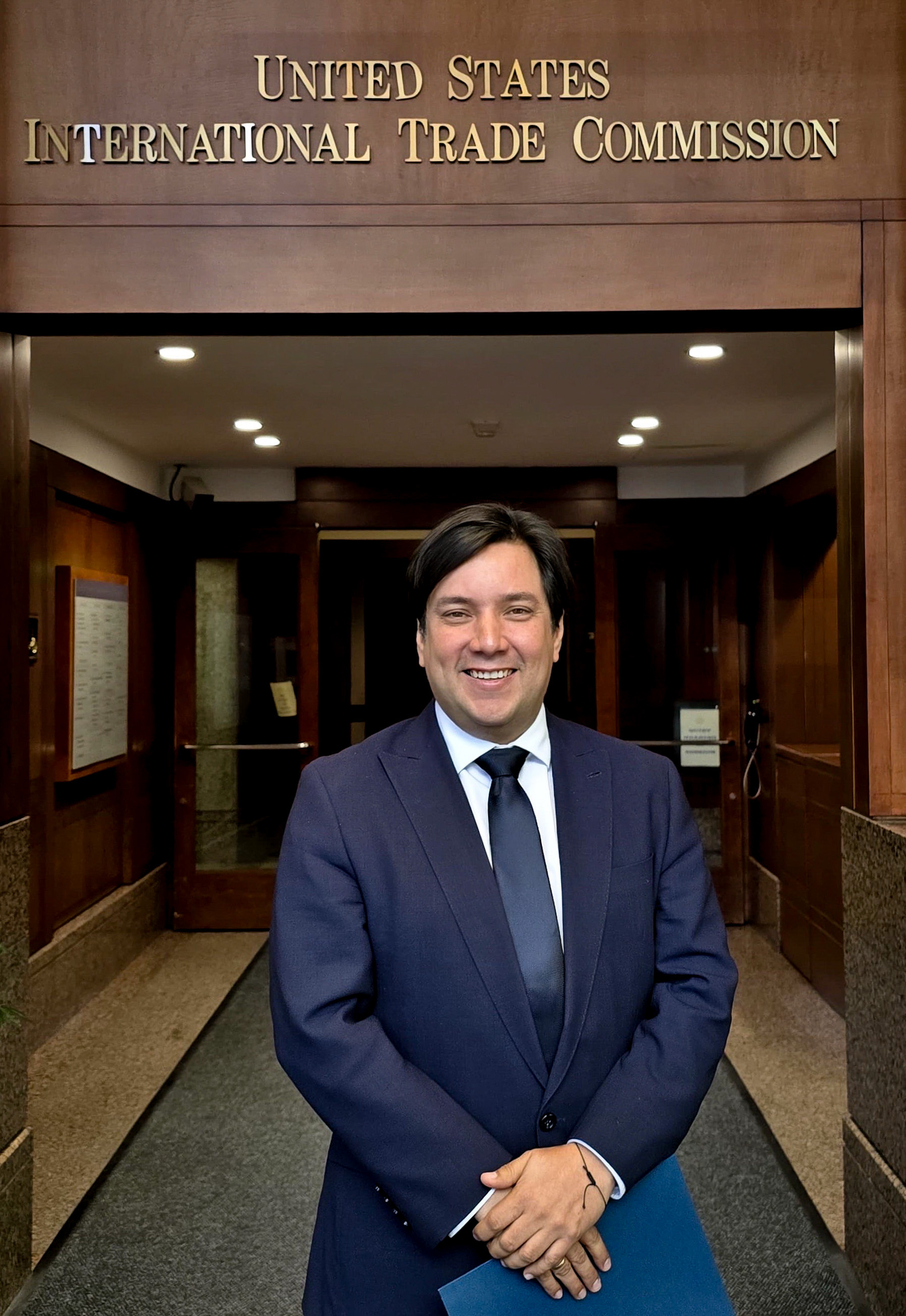
Julián Cárdenas, research professor and director of the Center for U.S. and Mexican Law at the University of Houston Law Center, testified before the Office of the U.S. Trade Representative.
Julián Cárdenas, research professor and director of the Center for U.S. and Mexican Law at the University of Houston Law Center, testified before the Office of the U.S. Trade Representative.
Dec. 10, 2025 ‒ As the United States, Mexico and Canada prepare for an upcoming review of the trade agreement linking the three countries, Julián Cárdenas, research professor and director of the Center for U.S. and Mexican Law at the University of Houston Law Center, offered testimony highlighting issues related to legal education and legal practice across North America.
Cárdenas was invited to be on a panel of testifiers recently at a three-day hearing before the Office of the U.S. Trade Representative as the office prepares for a formal review of the United States-Mexico-Canada Agreement (USMCA), a free trade agreement that took effect in 2020. It replaced the 1992 North American Free Trade Agreement. The hearing was held at the offices of the U.S. International Trade Commission in Washington, D.C. in early December.
“The USMCA remains a cornerstone of North American economic cooperation,” he said during the hearing. “The recent collaboration among our nations—such as the joint hosting of the 2026 FIFA World Cup—serves as an inspiring example of cross-border partnership.”
Other scholars on the panel included Barry Appleton, co-director and distinguished senior fellow at the Center for International Law, New York Law School, and David Gantz, Will Clayton Fellow for Trade and International Economics, at Rice University's Baker Institute for Public Policy.
Cárdenas noted that UH will host an international conference next year, the 2026 FIFA World Cup and North American Cross-Border Cooperation. The conference will highlight the importance of North American integration, he said.
“We hope this spirit of collaboration and shared understanding will guide the upcoming USMCA review process,” Cardenas added.
Mexico and Canada have conducted similar hearings with stakeholders there in preparation for the review, which is set for July 2026.
The Center for U.S. and Mexican Law conducts academic research on international legal issues between Mexico and the United States and is involved in projects dealing with legal education across the United States, Mexico and Canada. Cárdenas cited that mission in focusing on three issues related to legal education and practice in his testimony.
He emphasized the importance of TN professional visas for attorneys and researchers issued under the USMCA. “These visas can play an important role for cross-border legal practice, fostering legal education and promoting international law exchanges—all critical
to the durability and success of the USMCA,” he said. “The Center for U.S. and Mexican Law works to promote U.S. legal education among Mexican and Canadian law students and attorneys, many of whom go on to become licensed attorneys in the United States as highly skilled professionals in cross-border transactions. Therefore, maintaining and enhancing access for legal professionals ensures continued cooperation and legal development across our borders, strengthening U.S. economic competitiveness and the rule of law.”
Cárdenas also highlighted the Investor-State Dispute Settlement provision of the agreement, saying it is crucial for maintaining a stable and predictable legal environment for foreign investors. “By joining a global market, each nation benefits from access to international funding, technology and know-how, all advantages that require predictable rules governed by international law,” he said.
He noted that Mexico has recently enacted judicial and energy reforms. “While their outcomes remain to be seen, it is imperative to preserve the stability of the foreign investment protection regime established under the USMCA—particularly for investors operating in strategic sectors such as energy, manufacturing and technology,” he said. “A stable rule-of-law framework is essential for fostering cross-border investments and strengthening long-term economic security alignment with Mexico.”
Trade among the three countries is approaching $2 trillion annually, and Cárdenas said special care should be given to safeguard provisions of the agreement aimed at fostering supply chain integration, reducing trade barriers and promoting fair competition to ensure North America remains a leader in global markets. “These provisions are particularly important as technological advancements and shifting trade dynamics require resilient and predictable frameworks to support continued growth, investment, and innovation,” he said.
Cárdenas said after his testimony that the three-day hearing was a good opportunity for multiple stakeholders to share their views with the U.S. government.
“I advocated for civility, prioritizing the importance of predictability and rule of law between the three countries,” he said.

