

UH Law Professor Maleaha Brown Takes National Lead on Violence Prevention as Chair of ABA Commission

Maleaha Brown, clinical associate professor at the University of Houston Law Center, is serving as chair of the ABA Commission on Domestic & Sexual Violence.
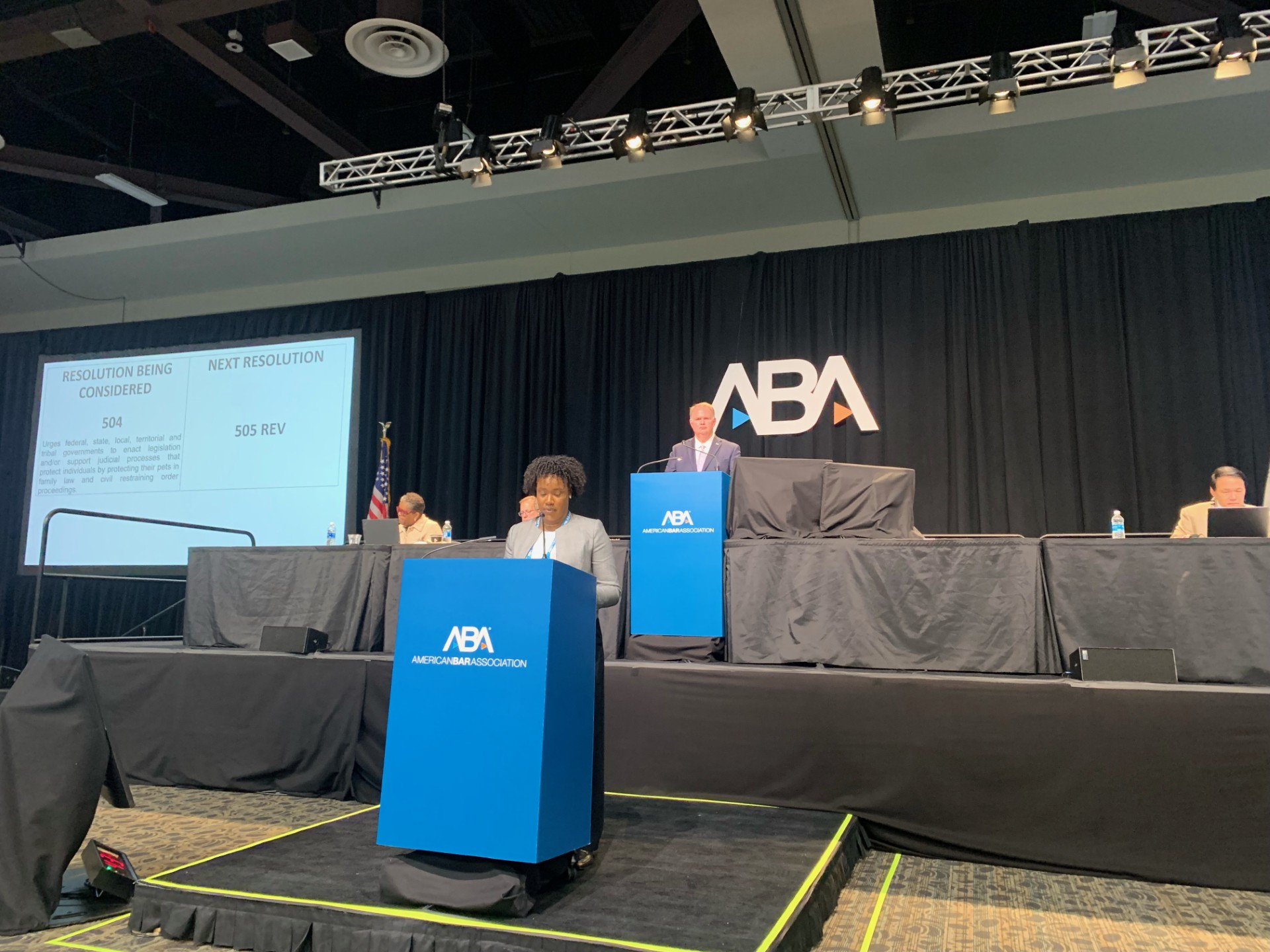
Professor Maleaha Brown introducing Resolution 504 to the ABA House of Delegates in February 2025
Maleaha Brown, clinical associate professor at the University of Houston Law Center, is serving as chair of the ABA Commission on Domestic & Sexual Violence.
Professor Maleaha Brown introducing Resolution 504 to the ABA House of Delegates in February 2025
DEC. 09, 2025— According to the Centers for Disease Control, more than 10 million adults experience domestic violence in America. For Maleaha Brown, a clinical associate professor at the University of Houston Law Center, that statistic is a call to action. Her appointment as chair of the American Bar Association’s Commission on Domestic and Sexual Violence provides her an important avenue to advance her mission to improve access to justice and resources for survivors.
“[This] is a full-circle moment for me,” Brown said. “[I] relied on the commission’s resources when I represented survivors as a legal aid attorney. I now have the opportunity to guide the commission’s policy initiatives and build on its 30-year legacy of advocacy and leadership.”
Her position, which started in 2024, is a one-year term, with the possibility of serving for up to two additional years, allowing Brown to advance national and ABA policy and strengthen support systems for survivors nationwide.
Before joining UHLC, Brown represented low-income survivors as a family law attorney with Texas RioGrande Legal Aid and the Legal Aid Foundation of Los Angeles. Being a part of the ABA aligns with Brown’s mission.
“I am committed to making the legal system more accessible for survivors of domestic and sexual violence, and the commission’s work is vital to increasing access to justice for survivors,” she said.
Since becoming chair, Brown has focused on addressing forms of domestic violence that often are hard to recognize and thus receive less attention, including economic abuse and harm to pets. Under her leadership, the commission introduced Resolution 504 to the ABA House of Delegates, which passed overwhelmingly in February.
Resolution 504 urges governments to enact laws and support judicial processes to protect domestic violence survivors and their pets. The policy ensures that survivors do not have to choose between their safety and the well-being of their pets, recognizing that pets are often a lifeline for those fleeing abuse. In surveys of pet-owning domestic violence survivors over the years, up to 89 percent have revealed that their pets were threatened, harmed, or killed by their abuser.
“As a former legal aid attorney myself who represented . . . survivors of domestic violence, I know all too well the many barriers that keep survivors from leaving abusive
relationships,” said Brown when she presented the resolution. “This resolution will help bridge the access-to-justice gap faced by those survivors with pets.”
The commission also partnered with organizations such as the American Veterinary Medical Association to elevate awareness of the link between domestic violence and animal abuse and neglect. “[We are] encouraging cross-disciplinary collaboration to address abuse to both survivors and their pets,” Brown said. The commission has also brought attention to economic abuse as a form of domestic violence. In October, Brown moderated a discussion on coerced debt and consumer legal protections for survivors.
Looking ahead, Brown plans to continue focusing on economic abuse and other forms of domestic violence. “In my second year as Chair, I would like the Commission to advance policy that expands legal protections for survivors who experienced economic abuse and equip lawyers and judges to work in trauma-informed, survivor-centered [ways].”
Brown is also an active member of the ABA’s Section of Family Law and serves on the editorial board of the section’s scholarly journal, Family Law Quarterly. She is the editor for the issue focusing on access to justice. Brown previously received its Howard C. Schwab Writing Contest and Allen Gary Palmer Excellence in Service and Commitment Awards.
At UHLC, Brown teaches Lawyering Skills and Strategies I and II and Family Law, bringing her commitment to access to justice into the classroom. Her broader advocacy includes years of leadership with Ms. JD, where she advanced opportunities for women in the legal profession. She earned her J.D. from Howard University School of Law and her B.A. from Baylor University.

